
For Vancouver artist Stephen Dancey, painting is an exploration of what paint can do rather than a depiction of a preconceived image. His primary artistic focus is about experimenting with the paint itself, letting the accumulated textures, marks and gestures, colours and layers guide the work to completion.
This approach embraces unpredictability, turning each painting into a unique journey of discovery with its own creative challenges. Through this intuitive practice, the final artwork emerges unplanned, as a tangible record of that exploratory process.
Alongside these process-driven abstract paintings, his abstract landscapes reinterpret the coastal islands, mountains, and waters of western Canada into textured, layered surfaces that prioritize tactile experience over depiction. His abstract watercolours extend this material focus, emphasizing fluidity, translucency, and non-traditional form. In a further act of material reclamation, his collages are built from dried palette paint, transforming studio waste into compositions that reveal the unexpected beauty of the salvaged medium.
Across all his work, paint is both a physical presence and a reflection of the creative act, resulting in complex surfaces that encourage viewers to spend time with his paintings, discovering new details as they explore the work further.
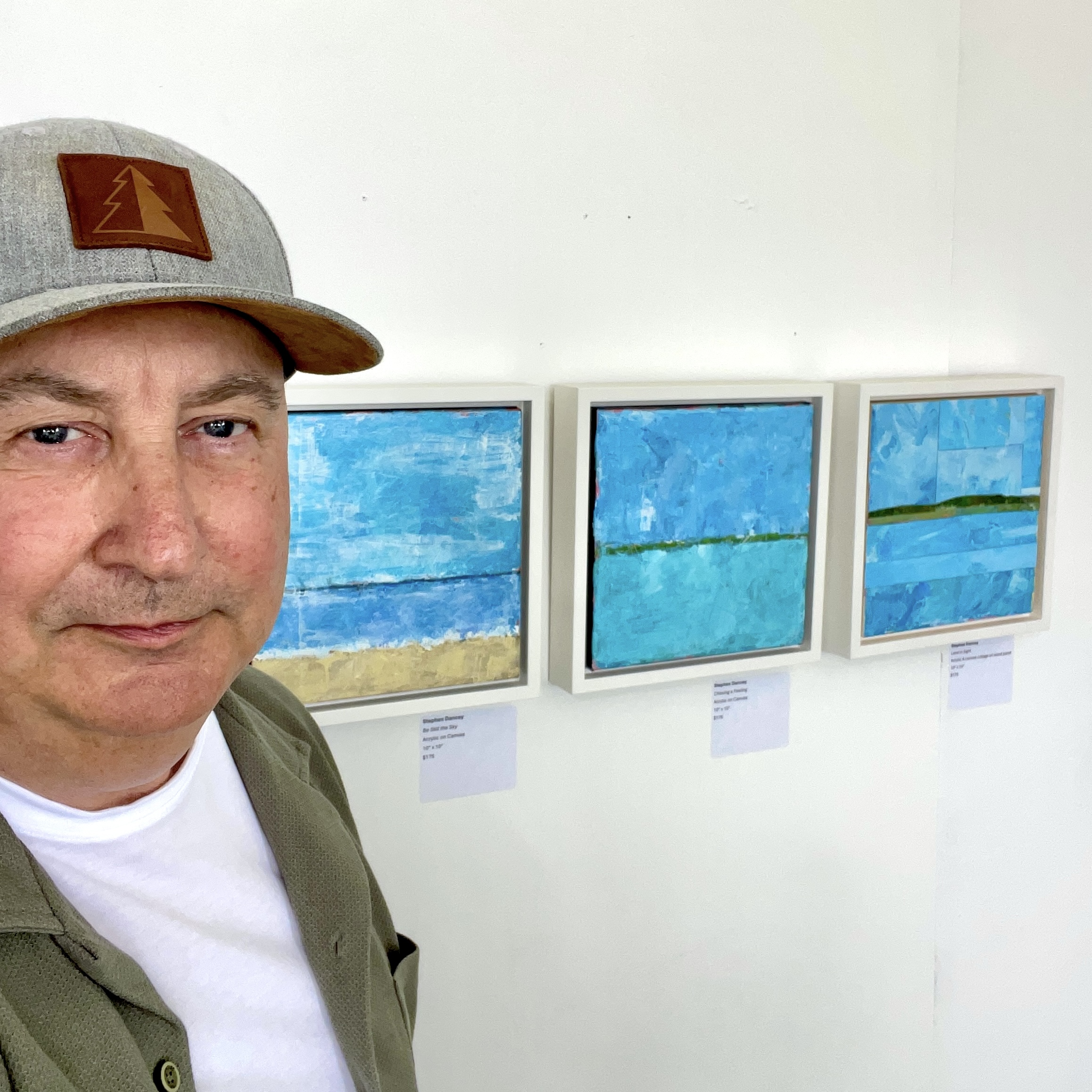
Alongside these process-driven abstract paintings, his abstract landscapes reinterpret the coastal islands, mountains, and waters of western Canada into textured, layered surfaces that prioritize tactile experience over depiction. His abstract watercolours extend this material focus, emphasizing fluidity, translucency, and non-traditional form. In a further act of material reclamation, his collages are built from dried palette paint, transforming studio waste into compositions that reveal the unexpected beauty of the salvaged medium.
Across all his work, paint is both a physical presence and a reflection of the creative act, resulting in complex surfaces that encourage viewers to spend time with his paintings, discovering new details as they explore the work further.
Artistic journey
Stephen Dancey has a BFA in Visual Arts from the University of Victoria. After graduating, he moved to London, England, where he entered the workforce and put his art on hold. Later he trained in magazine design at Central Saint Martins College of Art and Design and worked in that field in London.
During a summer holiday in Cornwall, he visited the Tate St Ives and other local galleries, and was deeply inspired by the art he saw, as well as the Cornish landscape and beaches. This inspiration led him to quickly create a series of small acrylic on paper studies upon returning to London, capturing his artistic vision for future work. Only two works survive from this time, Gwithian 3 and Gwithian 4, named after Gwithian Beach in St Ives Bay. Dancey’s current work continues to be informed by this initial inspiration.
After moving to Vancouver, Dancey continued to work in arts-related fields, first running his own graphic design business and later, with his wife, managing two dance studios and an annual dance festival. During this time he refined his artistic vision through photographing landscapes and seascapes in preparation for his return to painting in 2024.
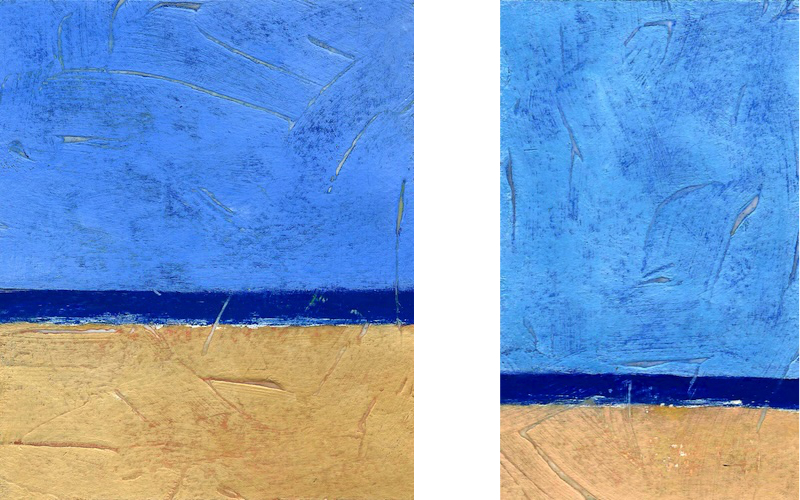
Gwithian 3 (left, 6×5 inches) and Gwithian 4 (right, 5×3 inches), both 1997.
After moving to Vancouver, Dancey continued to work in arts-related fields, first running his own graphic design business and later, with his wife, managing two dance studios and an annual dance festival. During this time he refined his artistic vision through photographing landscapes and seascapes in preparation for his return to painting in 2024.
Enquiries
For any questions, more information, or purchase enquiries, please email me at: hello@stephendanceyart.com. I welcome your enquiry and look forward to connecting.
Land acknowledgement
Stephen Dancey respectfully acknowledges that he lives and works on the unceded, traditional and ancestral territories of the xʷməθkʷəy̓əm (Musqueam), Sḵwx̱wú7mesh (Squamish), and səlilwətaɬ (Tsleil-Waututh) nations. Many of his paintings are inspired by these lands and he is committed to engaging with the land and its history in a respectful manner, recognizing the landscape’s profound cultural significance.